What Does FOB Mean in Freight Shipping?
30 Jul 2026
FOB decides who owns the freight while it is moving. It is a different question from who pays for the shipping, and confusing the two is how disputes start.
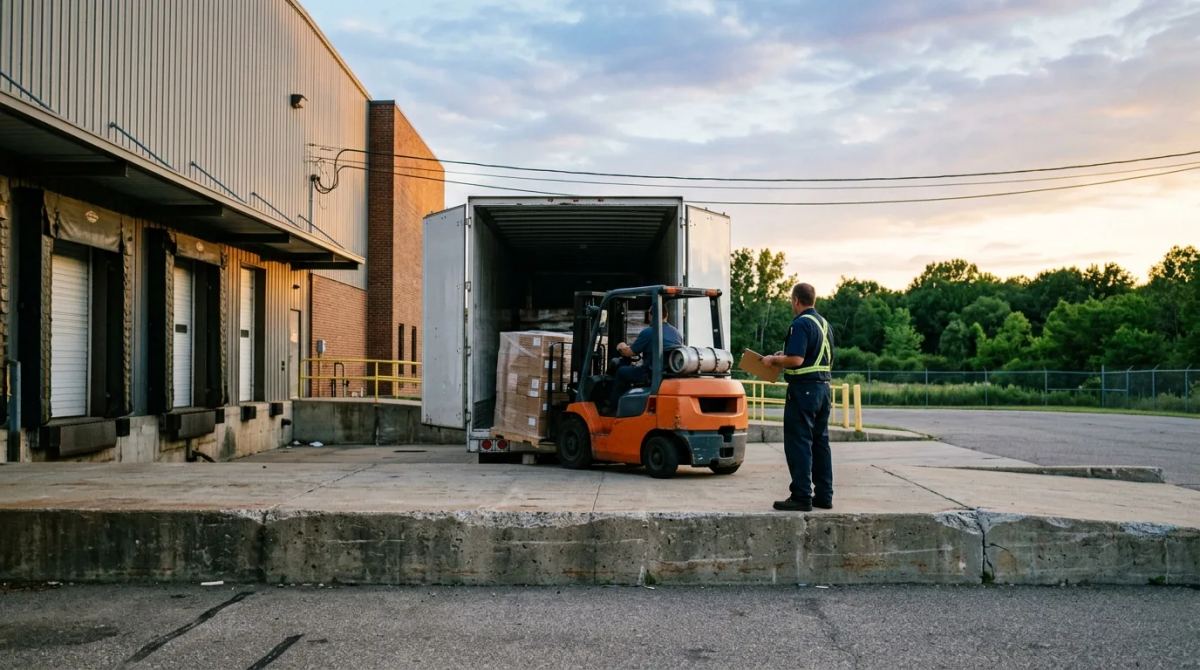
FOB, short for Free on Board, sets the point where ownership and risk pass from the seller to the buyer. It does not decide who pays for the shipping, which is a separate question with a separate answer.
The distinction has money attached. If a supplier ships on Monday under FOB Origin and the truck is in an accident on Tuesday, the loss belongs to the buyer, who has never seen the freight, never signed for it and never touched it. Confusing the two terms is where most freight disputes start.
What does FOB mean?
FOB stands for Free on Board. On a domestic purchase order or bill of lading it appears in one of two forms.
FOB Origin, also written FOB Shipping Point, means ownership and risk transfer to the buyer when the carrier collects the freight from the seller.
FOB Destination means the seller keeps ownership and risk until the freight arrives at the named delivery location.
The word "free" causes trouble here, because it has nothing to do with free shipping. It is nineteenth-century contract language meaning the seller's obligation ends at a named point, free of further duty. Everything after that point belongs to the buyer.
FOB Origin: what it means for you
Under FOB Origin the freight becomes the buyer's property the moment it is loaded onto the carrier's truck.
Practically, that means three things. If the freight is damaged or lost in transit, the loss is the buyer's and the buyer files the claim. The buyer records the inventory on the ship date, so goods still two states away sit on their books. And the freight cost, whoever pays it, generally belongs in the buyer's landed cost.
Sellers tend to prefer it because their exposure ends at their own dock. Buyers accept it because it usually comes with a lower price on the goods, since the seller is carrying less risk.
FOB Destination: what it means for you
Under FOB Destination the seller keeps ownership and risk for the whole journey. If the freight is damaged before it arrives, that is the seller's loss and the seller files the claim.
One detail worth knowing, because it comes up in arguments. Under the Uniform Commercial Code, risk passes when the goods arrive at the named place and are made available to the buyer. Your right to inspect does not delay that transfer. But it does not weaken your position either, because any damage that happened in transit happened while the seller still carried the risk, and the seller is responsible for it regardless of when you open the crate.
Buyers prefer FOB Destination for exactly this reason. It removes transit risk entirely and simplifies both the accounting and the argument.
FOB terms and freight terms are different questions
This is the part that causes the most confusion, and most guides get it half right.
FOB decides who owns the freight and who carries the risk. Prepaid, collect and third party decide who receives the carrier's invoice. They are independent, and every combination occurs.
| Combination | Who owns it in transit | Who pays the carrier | Who files a claim |
|---|---|---|---|
| FOB Origin, Freight Collect | Buyer | Buyer | Buyer |
| FOB Origin, Freight Prepaid | Buyer | Seller | Buyer |
| FOB Destination, Freight Prepaid | Seller | Seller | Seller |
| FOB Destination, Freight Collect | Seller | Buyer | Seller |
Rows two and four are the ones people assume cannot exist. They can, and they are common. You can be paying to move goods you do not own yet, and you can own goods somebody else is paying to move.
The rule underneath the table is short enough to remember: whoever owned it when it broke, files. Who paid the freight bill has nothing to do with it.
Who files the claim when freight is damaged?
The party who carried the risk at the moment of the damage. Under FOB Origin that is the buyer, whether or not the seller arranged and paid for the transport. Under FOB Destination it is the seller, whether or not the buyer paid the carrier.
What decides the outcome is rarely the FOB term, though. It is the evidence.
A claim turns on proving the freight was sound when the carrier took it and damaged when it arrived. That means the condition at pickup has to be documented, the delivery receipt has to be noted at delivery rather than signed clean and disputed later, and the carrier has to still be insured and in business when the claim lands.
A claim against a carrier whose insurance lapsed is a claim against nobody, and the FOB term on your purchase order will not help you. Who moves the freight matters as much as who owns it.
What FOB does to your books
The timing of the transfer has accounting consequences, and they are the reason your finance team cares about a term your logistics team set.
Under FOB Origin the seller records the sale when the goods ship and the buyer records the inventory at the same moment, so in-transit freight appears on the buyer's balance sheet before it exists at their dock. Under FOB Destination both entries wait for delivery.
It flows into landed cost too. Under FOB Origin the buyer generally owns the freight cost and adds it to landed cost. Under FOB Destination the freight is usually built into the purchase price and does not get added separately, which means adding it again is double counting.
FOB in domestic freight vs international trade
If you are moving a truckload inside the United States or into Canada, you can stop reading about Incoterms.
FOB began in maritime law, which is why so much written about it concerns vessels, ports and container terminals. That history matters for context and not much else. Domestic road freight in the US is governed by the Uniform Commercial Code, section 2-319 in particular, and the terms you will meet are FOB Origin and FOB Destination on a purchase order and a bill of lading.
Incoterms are a separate international set of rules published by the International Chamber of Commerce, and under them FOB has a narrower meaning tied to loading goods aboard a vessel. If a supplier overseas quotes you FOB, they mean the Incoterms version. If your customer in Ohio writes FOB Destination on a PO, they mean the UCC version. Same three letters, different rulebook.
How to set FOB terms without creating a dispute
Most FOB arguments are not about the law. They are about two parties who never actually agreed what they meant.
Four habits prevent almost all of it.
State the FOB term and the freight term together on the purchase order, in that order, so nobody has to infer one from the other.
Name the place. FOB Destination is incomplete without a destination. FOB Destination, Cleveland plant, is a term. FOB Destination on its own is an invitation to argue.
Make the bill of lading match the PO. When they disagree, the bill of lading tends to win in practice, because it is the document the carrier's system reads.
Settle it before the first shipment, not after the first problem. The cost of the conversation is ten minutes. The cost of not having it is whatever was on the truck.
Moving freight on any terms
LT2 Logistics arranges freight across the United States and into Canada on whatever terms the buyer and seller have agreed, including third-party billing where neither end wants a carrier invoice. Who owns the freight and who pays the carrier are separate questions, and prepaid versus collect settles the second one.
Where the terms matter to us is the part nobody plans for. Every carrier is verified before it touches your freight: operating authority, insurance and safety history, monitored on an ongoing basis rather than checked once at setup. On a claim, that verification is the difference between a carrier who can pay and a carrier who cannot. And on expedited loads, the driver photographs the freight and the paperwork before the vehicle moves, which is exactly the contemporaneous evidence of condition that a claim turns on.
If freight has been damaged and the terms are not clear, call us at (262) 888-3553 before anyone signs anything. Paperwork is easier to correct now than after a claim is filed. More on how our brokerage works.