What Is a Bill of Lading?
21 Jul 2026
The bill of lading is the one document every truckload shipment starts and ends with. It is also three documents at once, which is why signing it carelessly costs people money.
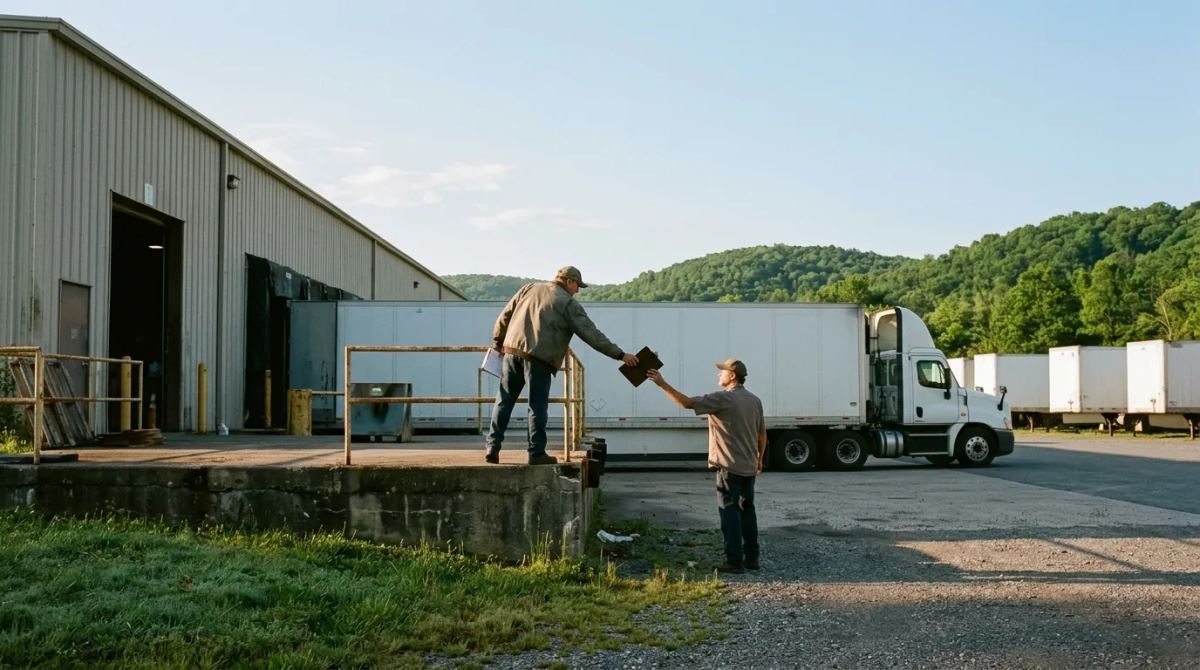
A bill of lading is the document that travels with a shipment. It records what was handed over, who it belongs to and where it is going, and it is signed at both ends of the journey.
It is also three things at once, which is the part that catches people out. It is a receipt for the freight, a contract between the shipper and the carrier, and in some forms a document of title that controls who owns the goods. Signing it does all three at the same time.
What is a bill of lading?
Every truckload and LTL shipment in the United States moves on one. The shipper prepares it before pickup, the driver signs it when the freight is collected, and the consignee signs it on delivery. At that point it becomes the proof of delivery, which the carrier uses to invoice and the shipper uses to confirm the freight arrived.
For interstate trucking the form and content are set by federal regulation under 49 CFR Part 1035, and carrier liability for loss or damage runs through the Carmack Amendment. That is why a bill of lading is not just paperwork: it is the document a claim is built on.
The three jobs it does at once
A receipt. The driver's signature at pickup says the carrier received this freight, in this quantity, in this condition. That is the baseline every later argument measures against.
A contract of carriage. The terms on the document govern the move: what is being hauled, where to, on what terms, and who is billed for it.
Sometimes a document of title. In its negotiable form, whoever holds the endorsed original controls the goods. This almost never applies to domestic trucking and it is covered below.
The reason to know all three is that people treat the bill of lading like a delivery note and it is doing considerably more work than that.
What has to be on it
A bill of lading that is short of detail is a bill of lading that generates a dispute. At minimum it carries:
Shipper name and address, consignee name and address, and the third-party biller if there is one. Origin and destination. A description of the freight, including commodity, weight, piece count and packaging. Any hazardous materials declaration. Special handling instructions. The freight charge terms, meaning prepaid, collect or third party. And the carrier's reference or PRO number once assigned.
The freight description matters more than it looks. It is what the carrier priced the move on and what a claim will be valued against, so "1 skid, machine parts, 1,240 lb" is worth writing properly rather than "1 skid".
Straight vs order: which one you actually need
Almost certainly a straight bill of lading.
A straight BOL is non-negotiable. The freight is consigned to one named receiver and cannot be redirected to anyone else by endorsing the document. It covers the overwhelming majority of domestic truckload and LTL shipments, and if you are moving freight between two US businesses this is what you are using.
An order BOL is negotiable. It is made out to the order of a party rather than to a named consignee, and whoever holds the properly endorsed original can take delivery. It exists so that goods can change hands while they are still moving, which is why it turns up in commodity trading and in international deals with a bank sitting in the middle. It is rare in domestic trucking.
You will also hear about through bills, master and house bills, VICS bills used by large retailers, and government bills. A blind shipment uses two or three versions of an otherwise ordinary straight BOL rather than a separate type. Those are variations for particular situations rather than a decision most shippers have to make. And an electronic bill of lading is not a separate type at all: any bill of lading can exist electronically and carries the same weight when both sides agree to use it.
Who signs what, and when
Three signature moments, and each one commits somebody to something different.
The shipper prepares it. This surprises people who assume the carrier produces the document. The carrier prints the form; the shipper supplies the content and is responsible for it being accurate.
The driver signs at pickup. That signature acknowledges the carrier received the freight as described and in apparent good order. A driver who notices a problem should note it on the document before signing, and a driver who refuses to sign a description they cannot verify is doing the job properly.
The consignee signs at delivery. This converts the bill of lading into the proof of delivery. It is also the single most consequential signature in the whole process, for the reason in the next section.
Clean vs claused: the signature that decides a claim
A clean bill of lading records no problems. A claused one, sometimes called dirty, records damage, shortage or a discrepancy noted at the time.
If freight arrives damaged and the receiver signs clean, they have created a document saying the freight arrived in good order. Reopening that later means arguing against your own signature, and claims are routinely denied on exactly that basis. Which party is entitled to file that claim at all depends on the FOB terms.
So the rule at delivery is simple and worth telling whoever actually receives your freight: look before signing, and write what you see. Count the pieces. Note visible damage on the delivery receipt in plain words. Photograph it. None of that takes long, and it is the difference between a claim with evidence and a claim without.
Concealed damage, which is damage found after the packaging comes off, is harder but not hopeless. Report it quickly and keep the packaging, because the packaging is part of the evidence.
What goes wrong, and how long to keep them
Four recurring errors, all avoidable at the desk:
A vague freight description, which leaves the claim value arguable and the rate open to correction.
The wrong freight charge terms box, which sends the invoice to the wrong party and delays payment by weeks.
Third party marked without a billing party named, which leaves the carrier no one to invoice, so it bills whoever it can identify.
Signing clean out of politeness because the driver is waiting. The driver would rather wait two minutes than be part of a claim argument later.
On retention: keep bills of lading for at least three years. That is roughly the limitation period for most freight claims, and a claim without the document behind it is difficult to pursue.
Getting the paperwork right
LT2 Logistics is a freight brokerage arranging freight across the United States and into Canada, and the paperwork is part of what we do rather than something that happens after the booking.
Every carrier is verified before it touches your freight: operating authority, insurance and safety history, monitored on an ongoing basis rather than checked once at setup. That matters on a bill of lading because a signed document is only as good as the carrier standing behind it. And on expedited loads the driver photographs the freight and the paperwork before the vehicle moves, which is contemporaneous evidence of condition at pickup and exactly what a claim turns on.
If you are working out how a shipment should be documented, call us at (262) 888-3553 and describe the arrangement. We will tell you what the paperwork needs to say. More on how our brokerage works.