What Is Freight Class?

18 Aug 2026
Freight class is the number that decides what an LTL shipment costs. Since 2025 it is set mainly by density, and a calculator alone will not always give you the right answer.
Freight class is the number that decides what an LTL shipment costs. It runs from 50 to 500, and lower is cheaper.
Since July 2025 it is set mainly by density, which is your freight's weight divided by the space it occupies. That is a change from how the system worked for decades, and it is why some LTL invoices have looked different lately.
What is freight class?
Freight class is a standardised way of categorising LTL freight so that carriers price the same shipment the same way. It comes from the National Motor Freight Classification, maintained by the NMFTA.
There are 18 classes between 50 and 500. Class 50 is dense, durable freight that stacks and travels well, and it earns the lowest rate per hundredweight. Class 500 is light, bulky or fragile freight that fills a trailer without weighing much, and it costs the most. Most retail and consumer goods land somewhere between class 70 and class 175.
The logic underneath is simple. A carrier sells trailer space. Dense freight lets them put more billable weight in the same space, so it costs less to move per pound. Light bulky freight buys cube rather than weight, and gets priced accordingly.
The four factors
Density is weight relative to the space occupied, and since 2025 it is the primary factor for most freight.
Handling covers anything that makes the freight awkward to move: odd shapes, fragility, special equipment.
Stowability is how well it fits alongside other freight in a trailer. Hazardous goods, overlength items and anything that cannot be stacked score badly.
Liability is the risk of damage, theft or loss, which is why high-value and perishable freight classes higher.
For ordinary palletised freight, density does most of the work. The other three matter when the freight is unusual.
Estimate your freight class before you ship
Enter the dimensions and weight and get the class your density suggests, with the full NMFC scale alongside it.
Open the calculatorHow to calculate it
Three steps, and you can do all of them before you book anything.
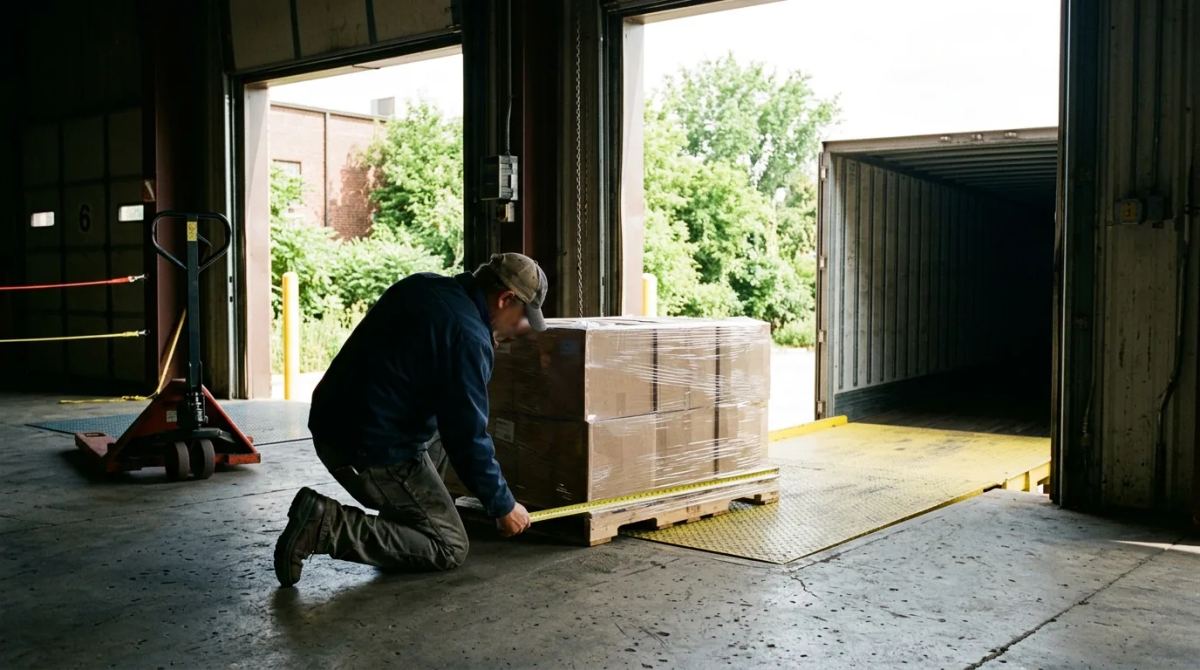
Measure the shipment. Length, width and height in inches, at the longest, widest and tallest points, including the pallet and any overhang.
Convert to cubic feet. Multiply length by width by height, then divide by 1,728.
Divide weight by volume. Total weight in pounds divided by cubic feet gives density in pounds per cubic foot.
A worked example. A pallet measuring 48 by 40 by 48 inches is 92,160 cubic inches, which is 53.3 cubic feet. If it weighs 500 pounds, the density is 9.4 pounds per cubic foot, which puts it in class 100. You can run the same calculation with our freight class calculator.
| Sub | Density (lb per cubic foot) | Class |
|---|---|---|
| 1 | Under 1 | 400 |
| 2 | 1 to under 2 | 300 |
| 3 | 2 to under 4 | 250 |
| 4 | 4 to under 6 | 175 |
| 5 | 6 to under 8 | 125 |
| 6 | 8 to under 10 | 100 |
| 7 | 10 to under 12 | 92.5 |
| 8 | 12 to under 15 | 85 |
| 9 | 15 to under 22.5 | 70 |
| 10 | 22.5 to under 30 | 65 |
| 11 | 30 to under 35 | 60 |
| 12 | 35 to under 50 | 55 |
| 13 | 50 and above | 50 |
This is the FCDC 13-subprovision scale, effective 19 July 2025. Classes 77.5, 110, 150, 200 and 500 do not appear on it — they exist only in commodity-specific NMFC listings where handling, stowability or liability sets the class instead.
Measure the whole pallet
This is the commonest and most expensive error, and it is entirely avoidable.
Carriers measure the handling unit as it sits on their dock. That means the pallet itself, the wrap, and anything hanging over the edges. Shippers routinely measure the cartons, calculate a flattering density, declare a low class, and get corrected.
Weight works the same way. The declared weight should include the pallet, not just the goods on it.
What changed in 2025
On 19 July 2025 the NMFTA moved the classification system from commodity-based to density-based for most freight. Roughly 6,000 NMFC items changed. A further docket in February 2026 cancelled more legacy items and tightened the structure.
For decades, class followed what the product was. A pallet of plastic chairs had one item number and a pallet of metal chairs had another, regardless of how they were packed. Now, for most commodities, class follows how densely the freight is actually packed.
Two practical consequences. Bill of lading templates built before mid-2025 may carry classes that are no longer right, and cost models built on the old structure will be out of line. If your LTL invoices have looked unfamiliar since then, this is the likeliest reason.
When density is not the answer
Density does not set every class, and a calculator that implies otherwise is wrong.
The density scale has 13 classes while the full system has 18. The five off-scale classes shown above apply only through commodity-specific NMFC listings.
So freight that is hazardous, fragile, high-value, oddly shaped or difficult to stow can carry a class that its density alone would not predict. For that freight, the density calculation gives you a starting point and the NMFC item gives you the answer.
The practical rule: use density for ordinary palletised goods, and check the NMFC item when the freight is unusual in any way.
What reclassification costs
When a carrier measures your freight and finds it does not match the bill of lading, the shipment is reclassified and rebilled.
The cost is not just the difference between two classes. It is the corrected rate plus an adjustment, and it arrives after delivery, when the freight is gone and your bargaining position went with it. Disputing it means proving your measurements against theirs, and they have the dock scale and the dimensioner.
Which is the argument for measuring properly rather than estimating. The five minutes at the dock is cheaper than the correction, which arrives as a reclassification fee alongside whatever other accessorial charges the shipment picked up.
Getting the class right before you ship
LT2 Logistics arranges LTL across the United States and into Canada, and class is one of the things worth settling before a shipment is tendered rather than after it is delivered.
If you have measured a pallet and are not certain what class it should carry, or if the freight is unusual enough that density will not settle it, call us at (262) 888-3553 with the dimensions, the weight and what the freight actually is. We will tell you what it should be classed as before it ships. More on how we arrange LTL.