LTL Shipping Explained

13 Aug 2026
LTL means your freight shares a trailer with other shippers and moves through terminals. It is the cheapest way to move a few pallets, and there are three situations where it is the wrong answer.
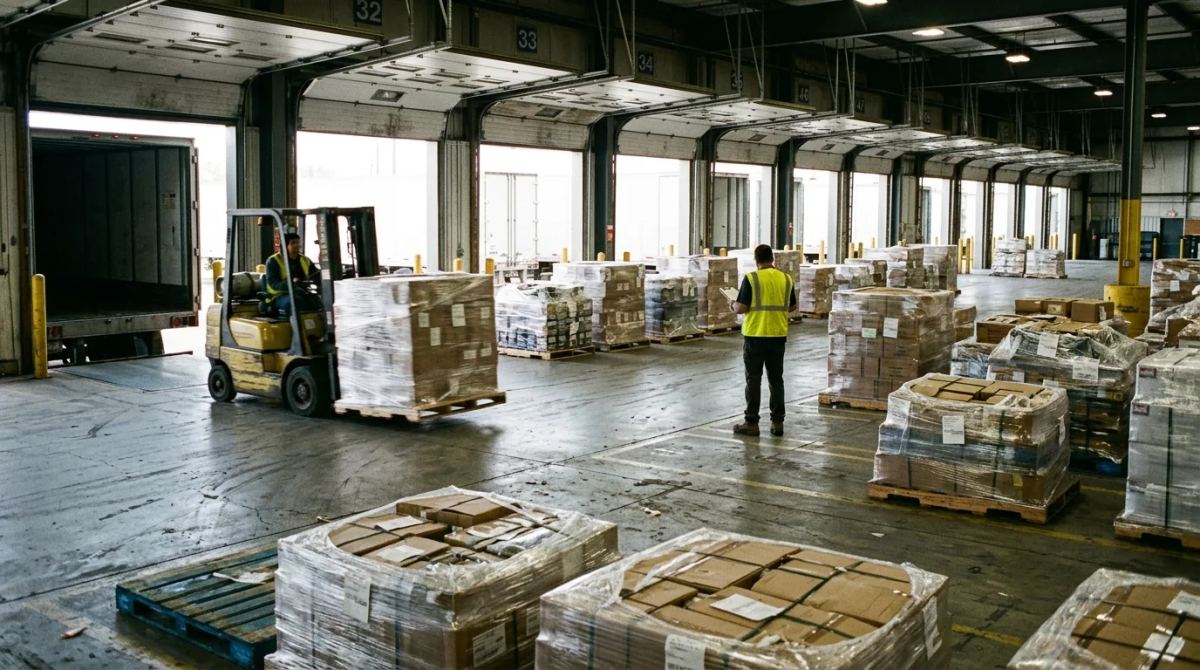
LTL stands for less-than-truckload. Your freight shares a trailer with shipments from other companies and travels through a network of terminals rather than going straight from your dock to the destination.
You pay for the space you use instead of the whole truck, which makes it the cheapest way to move a few pallets. What you give up is speed, predictability, and the number of times your freight gets handled.
What is LTL shipping?
LTL covers freight from roughly 150 to 15,000 pounds, or about one to six standard pallets.
Below 150 pounds, parcel carriers are usually cheaper. Above 15,000 pounds, or once the freight fills more than about half a trailer, truckload pricing normally wins. Between those two points sits LTL, and for that band it is typically 60 to 80 percent cheaper than booking a full truck.
There is an exception at the top end. Volume LTL, sometimes called partial, handles freight that has outgrown standard LTL but does not need a dedicated trailer, and it is worth asking about before defaulting to a full truck.
How your freight actually travels
The sequence matters, because every step in it is a place where time is added and freight is touched.
A local truck collects your pallets and takes them to the carrier's origin terminal. There the freight is unloaded, sorted, and consolidated with other shipments heading the same direction. It moves by linehaul to a destination terminal, sometimes via an intermediate hub where it is cross-docked onto a different trailer. At the destination terminal it is sorted again and loaded onto a local truck for delivery.
That is a minimum of four handling events and often more. It is also why an LTL carrier can move a single pallet across the country for a few hundred dollars, and why it takes longer than a truck driving there directly.
Estimate your freight class before you ship
Enter the dimensions and weight and get the class your density suggests, with the full NMFC scale alongside it.
Open the calculatorWhat LTL costs, and what moves the number
Six things set an LTL rate.
Freight class, which is driven mostly by density. Covered in its own section below.
Weight, in bands rather than continuously, so crossing a threshold can change the rate more than the extra pounds suggest.
Distance, and the specific lane rather than the mileage alone.
Accessorials, meaning anything beyond dock-to-dock: liftgate, residential delivery, inside delivery, appointment scheduling, redelivery.
Fuel surcharge, applied as a percentage on LTL rather than the per-mile figure used on truckload.
The carrier minimum, which is the floor no shipment prices below regardless of how small it is.
Freight class and density
Freight class is the part shippers have the most control over and pay the least attention to.
Class is assigned on four factors: density, handling, stowability and liability. For most ordinary freight, density does the heavy lifting. Dense freight that packs tightly gets a lower class and a lower rate. Light, bulky freight that takes up space without weighing much gets a higher class and costs more.
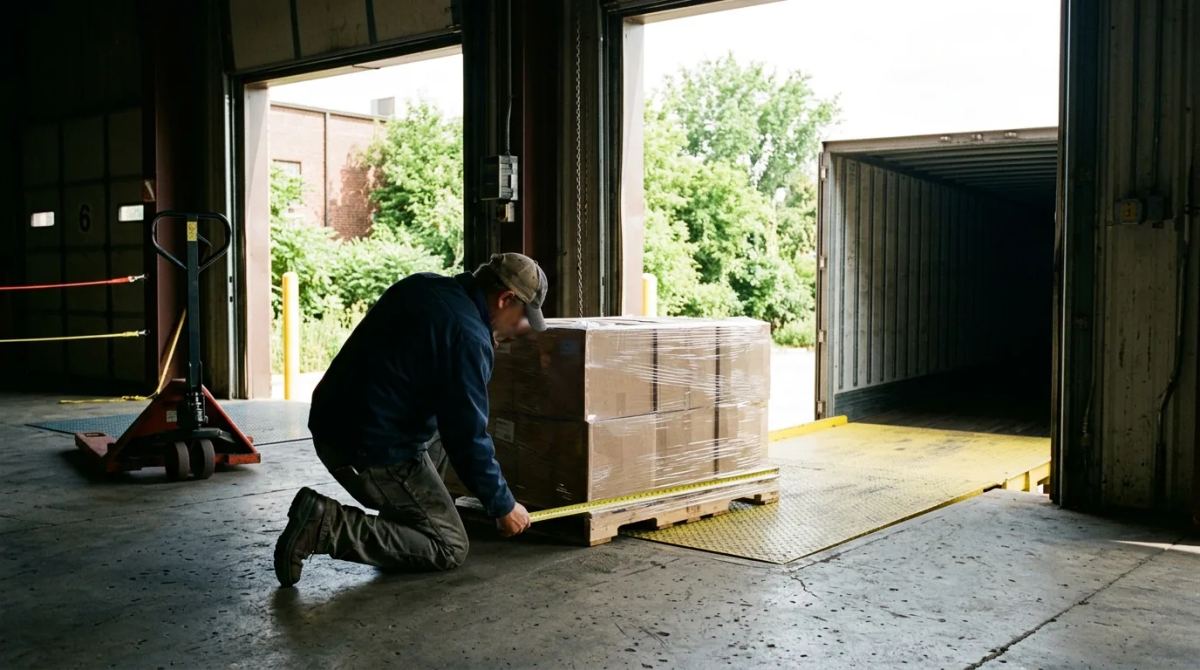
Density is calculable before you tender anything. Measure the pallet including the pallet itself, then use the dimensions and total weight to estimate the class. That number is the one lever you can pull without negotiating with anybody.
Getting it wrong is expensive in a specific way. If the carrier measures your freight and finds it does not match the bill of lading, the shipment is reclassified and rebilled, usually at a worse rate than if you had declared it correctly in the first place.
How long LTL takes
Three bands, and they hold reasonably well across carriers.
Regional moves under about 500 miles run one to two business days. Long-haul between roughly 500 and 1,500 miles run two to four. Cross-country runs five to seven.
Those are business days, not calendar days, and they are estimates rather than commitments. Standard LTL service does not come with a guaranteed delivery date. Carriers sell guaranteed service separately, at a premium, and if a date genuinely cannot move that is the product to ask for rather than hoping the standard estimate holds.
The system will not bend for your shipment
This is the thing that catches shippers coming from truckload, and it is worth understanding before it costs you.
LTL is a shared network built over a century to move millions of shipments on fixed, sequenced routes. It does not adjust for individual loads. A truckload driver hauling only your freight can wait while you find someone to approve an extra charge. An LTL driver running a route with fifteen other deliveries cannot.
So if an accessorial is genuinely needed to complete the delivery, the carrier performs it and bills you. Withholding approval does not save the money. It means the driver either sits accruing detention or takes your freight back to the terminal, where a failed delivery fee and daily storage start instead.
Working with the network gets freight delivered. Working against it gets it delayed and billed anyway.
Why LTL freight gets damaged
Because it is handled four or more times, and most damage traces back to how the pallet was built rather than to rough treatment.
Pallets that shift in transit are the leading cause of LTL damage claims. Three things prevent most of it.
Build the pallet properly. Heaviest items at the base, weight distributed evenly, nothing overhanging the edges where it can be caught by a forklift.
Wrap the load to itself first, then anchor it to the pallet. Wrapping straight to the pallet creates a load that pivots on uneven terminal floors. Four passes at the base and four at the top is the working minimum.
Label every pallet. One label per pallet, on the long side, facing outward, carrying the shipper, consignee, PRO number and class. A missing label does not just risk a lost pallet, it commonly adds 24 to 48 hours while the terminal works out where the freight belongs.
Regional vs national carriers
Not all LTL carriers are the same shape, and this is the choice somebody else makes for you when you do not make it yourself.
A national carrier has terminals everywhere and can move freight anywhere, which is what you want on a long or unusual lane. A regional carrier covers a smaller footprint with denser coverage inside it, and within that footprint it is frequently both faster and cheaper, because your freight passes through fewer terminals.
The practical version: on a Wisconsin to Ohio lane, a strong Midwest regional will often beat a national carrier on both transit and rate. On Wisconsin to Arizona, it will not be an option at all.
Every LTL carrier writing about LTL is one or the other, which is why this comparison is hard to find. The full range of carrier types is worth knowing before you accept a quote.
When LTL is the wrong answer
Three situations, and it is worth being direct about them.
Above about six pallets. The economics tip. Partial truckload or volume LTL usually costs less per unit and handles the freight far less.
When the delivery date is firm. Standard LTL transit is an estimate. If a missed date costs real money, a dedicated truck removes most of the variables that make LTL unpredictable. On one to four pallets that usually means a sprinter van, which runs direct and dedicated without the cost of a full trailer.
When the freight is fragile or high value. Four handling events is four opportunities for damage. Freight that cannot tolerate that should not be in a shared network, whatever the rate says.
Getting LTL moved
LT2 Logistics arranges LTL across the United States and into Canada through a broad carrier network, with one point of contact handling your shipment rather than a queue.
Because we are a broker rather than an LTL carrier, we are not trying to route your freight through one particular network. On a given lane that means comparing regional and national options and telling you which one actually suits the shipment.
If you are not certain whether a shipment belongs in LTL at all, call us at (262) 888-3553 with the pallet count, the weight and the lane, and we will tell you which mode it should be in before quoting anything. More on our LTL service.