What Is Expedited Freight? Cost, Speed and When It's Worth It

14 Jul 2026
Expedited freight costs more and moves faster. The useful questions are how much more, how much faster, and whether the hours you gain are worth the premium you pay.

Expedited freight moves faster than standard transit because of how it is routed, not because the trucks go quicker. One vehicle, committed to your load, running direct from pickup to delivery with no terminal stops and no waiting for a trailer to fill. Depending on distance and equipment, it typically costs somewhere between 30 percent and three times a standard rate.
That is a wide range, and the range itself is the useful part. This guide covers what expedited freight actually is, what the various words mean, how much time you gain in practice, and how to work out whether the premium is worth paying on a particular load.
What is expedited freight?
Expedited freight is any shipment moved on a compressed timeline using a dedicated vehicle and direct routing, rather than travelling through a carrier's normal network.
Standard freight travels through that network. Your shipment goes to a terminal, gets consolidated with other freight, rides to a hub, transfers to another truck, and works its way toward the destination. Every handoff adds time and another chance for something to go wrong.
Expedited removes those steps. Nothing about the truck is faster. The gain comes entirely from taking steps out.
What makes freight "expedited"?
Four mechanisms, and most expedited moves use at least two.
A dedicated vehicle. The truck, van or trailer carries your freight and nothing else. It does not wait to fill up and it does not divert to collect somebody else's load.
Direct routing. Origin to destination with no terminal in between. No consolidation, no sorting, no transfer between trailers.
Team drivers. On long runs, two drivers alternate so the vehicle keeps moving through hours that would otherwise be spent parked. One rests while the other drives. How much distance a team actually covers decides whether the second driver is worth paying for.
Immediate dispatch. Standard freight is booked into a schedule. Expedited capacity is sourced for the load in front of it, often for pickup within hours rather than days.
Expedited, express, same-day, hot shot: what the words mean
These terms get used interchangeably across the industry and they do not mean the same thing. The distinction matters mostly because it decides who you should be calling. Hot shot in particular is an equipment type rather than a service level, and the two get conflated constantly.
| Term | What it usually means | Who provides it |
|---|---|---|
| Expedited freight | Palletised or truckload cargo on a dedicated vehicle, direct | Freight carriers and brokerages |
| Express / priority | Small packages on a published parcel service level | Parcel carriers |
| Same-day | Pickup and delivery inside one working day, usually regional | Couriers and expedited providers |
| Time-critical | Expedited where a missed deadline has a hard, costly consequence | Expedited specialists |
| Hot shot | Urgent open-deck freight on a heavy-duty pickup and trailer | Expedited and flatbed providers |
| Courier | Documents and small parcels, usually local | Courier companies |
The short version: if it fits in a box, you want parcel. If it sits on a pallet or fills a truck, you want expedited freight.
How much faster is it, really?
On a lane where standard freight runs three to five business days, expedited commonly delivers in one to two, and shorter runs can be same day.
The arithmetic behind that is worth knowing. A solo driver covers roughly 500 to 650 miles in a day, limited by federal hours-of-service rules rather than by distance. Two drivers alternating can keep a vehicle moving well past 1,000 miles a day. That is where the largest time gains on long lanes come from, and it is why team service costs more than a single driver.
On short and medium runs the gain comes from somewhere else: no terminal, no consolidation wait, and dispatch within hours rather than days.
What does expedited freight cost?
Published figures disagree, and it is worth understanding why rather than picking one. Some sources put expedited at two to three times a standard rate. Others put the premium at 30 to 100 percent. Both are accurate, on different loads.
Four things decide where a given shipment lands in that range.
How much notice you give. A load booked three days out is priced from available capacity. The same load booked for pickup in four hours is priced from whatever is close enough to get there, which is a much smaller pool. Notice is the single biggest lever a shipper controls.
Whether the equipment fits the freight. Covered in its own section below, because it is where most of the avoidable cost sits.
Where it starts and ends. A pickup in a dense freight market has vehicles nearby. A pickup two hours from anywhere means somebody drives two hours empty before your load is even on, and that gets paid for.
Whether the vehicle has anything to do next. A vehicle running into a market with outbound freight prices better than one that will sit or come back empty.
Matching the vehicle to the load
This is where shippers most often overpay, and it is the easiest thing to fix.
Expedited does not mean a full truck. Two pallets that need to be somewhere tomorrow do not need a 53-foot trailer, and booking one can cost several times what a sprinter van would for identical transit time. The vehicle should be chosen from the size of the freight, not from the urgency of it.
| Vehicle | Typical fit | Why you would choose it |
|---|---|---|
| Sprinter or cargo van | 1 to 3 pallets | Cheapest way to move small urgent freight at expedited speed |
| Straight or box truck | 4 to 12 pallets | More capacity without paying for a tractor-trailer |
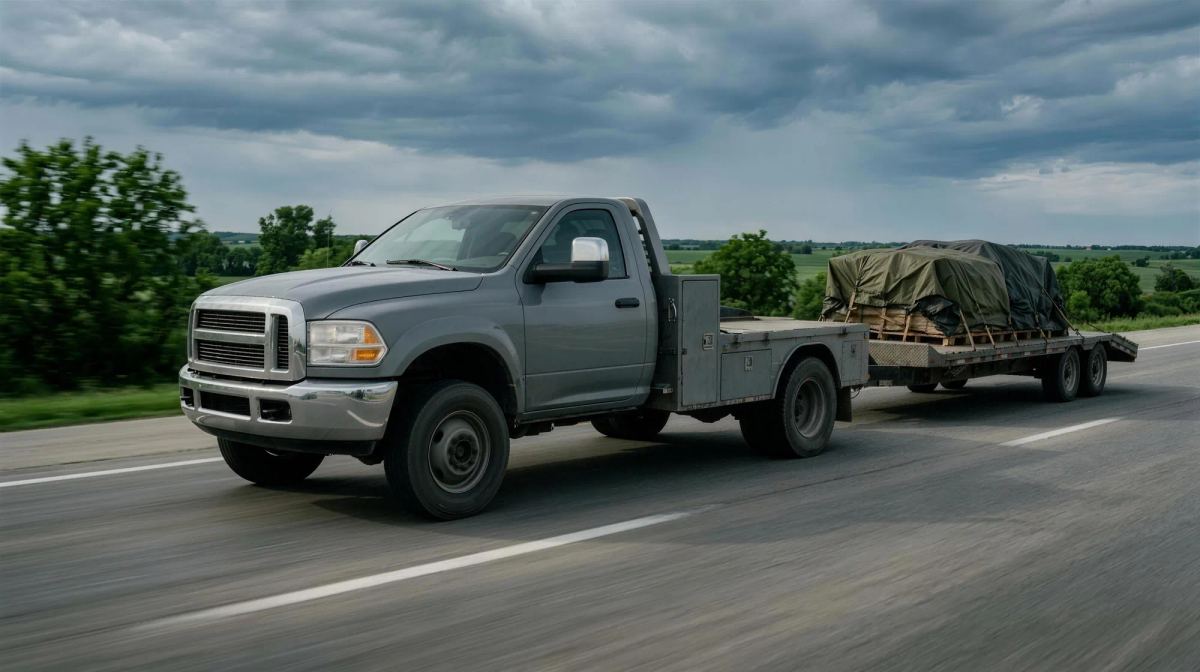
| Hot shot | Small or awkward open-deck loads | Flatbed capability at a lighter, quicker footprint |
| Tractor-trailer | Full or near-full loads | When the freight genuinely needs the space or the deck, and you can give us notice to source one |
Tell whoever is quoting the load what the freight actually is, in pallets and pounds, rather than asking for the fastest truck. The quote will usually come back lower.
Who ships expedited freight, and what goes wrong
Every guide on this subject lists the same industries and none of them explain what actually fails. The failure is the useful part, because it is what you learn to recognise.
Manufacturing: a line goes down. A component runs out and the production line stops. Every hour has a knowable cost that the plant already tracks, and it is almost always larger than the freight.
Paint and chemicals: the carrier pool is smaller. Much of this freight is regulated, which means the truck has to be placarded and the driver endorsed. When a date is fixed and the qualified pool is already narrow, expedited is often the only option that still holds.
Events: the date is the whole point. Materials for a show, an install or an opening are worth their full value the night before and very little the morning after.
Healthcare and pharmaceutical: a window closes. Product with a temperature or shelf-life constraint stops being sellable at a fixed point.
Retail and promotional: the date will not move. A launch, a seasonal set or a campaign has a date fixed by somebody else, and arriving after it is close to not arriving.
Construction and projects: a crew is waiting. Labour and equipment are booked for a day, and material that misses that day costs the whole day. The larger exposure sits further out. A job site that stands still because your delivery did not arrive is how a supplier stops being reliable and starts being a risk the customer would rather not carry.
What triggers the shipment is usually further upstream than the freight: a supplier missed a date, a forecast was short, a quality hold released late, or a customs check ate the buffer. Expedited freight is the tool that recovers the schedule, and it is almost always a symptom of something that happened earlier.
How to work out whether expedited is worth it
Every guide says to weigh the premium against the cost of being late. Almost none say how.
The arithmetic is simpler than it looks. Work out what an hour of the delay actually costs, then multiply by the hours the expedited option saves. If that number is larger than the premium, expedite.
What an hour costs depends on what is waiting. A stopped production line has a knowable hourly figure. A missed retail delivery window can carry a chargeback with a stated value. A contractual date may carry a penalty written into the agreement. In each case somebody in the business already knows the number, and it is usually far larger than shippers assume when they are looking at a freight quote in isolation.
Where the calculation gets harder is when the cost is reputational rather than contractual, and that is the cost shippers most often leave out. A late load does not only cost the day it delays. It changes how your customer thinks about you. One missed date is an incident. A pattern of them makes you the supplier whose deliveries have to be planned around, and that is a position you cannot buy your way back out of with a freight rate. There is no arithmetic for it, which is precisely why it tends to be underweighted against a quote sitting on the screen in front of you.
When expedited is not worth it
Three situations, and we would rather tell you than take the booking.
The deadline has slack in it. If the delivery window has a day or two of room, standard truckload is cheaper and gets there. Paying an expedited premium for a load that was never going to be late is money spent on nothing.
The freight is going to sit on arrival. A load that arrives at 6am on Saturday to a receiver that opens Monday has gained nothing from expedited transit. Check the receiving end before paying for speed at the shipping end.
You are expediting the same lane every month. This one matters more than the other two. Occasional expedited freight is a safety net. Regular expedited freight on the same route is usually a symptom of something upstream: a supplier lead time that no longer matches reality, a forecast that is consistently short, or a production schedule built on transit assumptions that were never true. Expediting fixes the shipment. It does not fix the pattern, and it is an expensive way to keep not noticing.
What happens after you book
Most of what is written about expedited freight describes the service and stops there. The part that decides whether it works is what happens between pickup and delivery.
Every expedited load LT2 arranges is tracked continuously through MacroPoint, and we stay in direct contact with the driver or their dispatch for the length of the run. Before a van leaves the pickup, the driver sends photographs of the load and the paperwork, and our team approves them, so a problem gets fixed on the dock rather than discovered at delivery. At delivery, signed paperwork goes to you straight away rather than the next morning.
Every carrier is verified before it touches your freight: operating authority, insurance and safety history, monitored on an ongoing basis rather than checked once. And when you call, a person answers.
On a time-critical load, that is the difference between knowing and hoping.
Getting an expedited quote
Tell us the pickup and delivery, what the freight is in pallets and pounds, and the deadline you are working to. That is enough to price it and to tell you honestly whether it can be done.
LT2 Logistics is a freight brokerage arranging expedited freight across the United States and into Canada, from sprinter vans to tractor-trailers. We are a brokerage backed by an asset-based carrier, Laufer Trucking, which has been running its own trucks since 1977, so the transit expectations you get come from people who have run the lanes. If the deadline cannot be met, we will say so rather than string you along.
If a load is getting tight, call us at (262) 888-3553 with the deadline before you commit to anything. If it does not need expediting, we will tell you that as well. More on how our expedited service works.