What Is Hot Shot Trucking? Loads, Limits and When to Use It
22 Sept 2026
Hot shots move urgent freight on an open deck when a van is too small and a full flatbed is too much. Let us review what works best on hot shots.
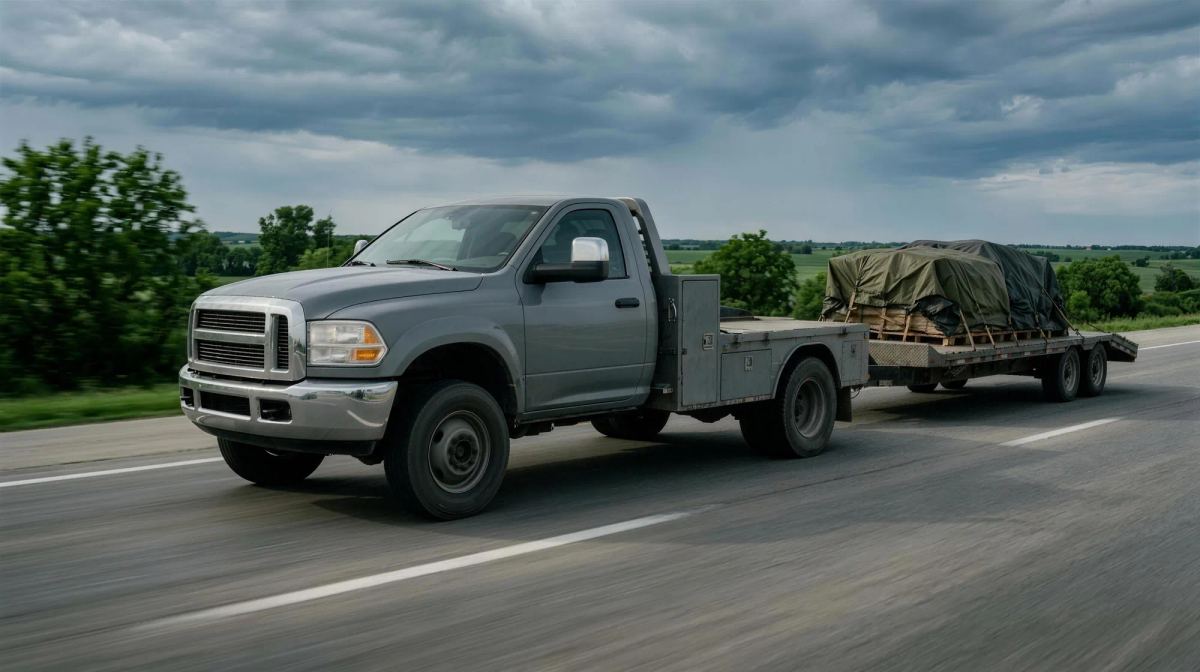
Hot shot trucking is expedited freight moved on an open deck — usually a heavy-duty pickup pulling a gooseneck flatbed, running direct from pickup to delivery. It exists for freight that is too big for a van, too urgent to wait for a full flatbed, and often too tall or awkward to go inside a truck at all.
The term gets used loosely, but we will cover what it actually is and what it can actually do below.
What is hot shot trucking?
Hot shot trucking is the expedited movement of a partial load on an open deck, typically using a Class 3 to Class 5 pickup paired with a gooseneck or bumper-pull flatbed trailer, dispatched for one customer and driven straight through.
Two things define it. The deck is open, so the freight is strapped and tarped rather than enclosed. And the load is dedicated, so the truck carries your freight and nothing else.
It started in the Texas oilfields in the 1970s, when a rig going down meant a part had to reach a remote site immediately and a full semi was neither available nor necessary. The name stuck and the practice spread well beyond oil and gas.
What hot shot actually carries
Hot shot sits in a specific gap: shipments larger than a few skids, but smaller than a trailer load, and too time sensitive to be combined with other freight.
Machinery and equipment. A replacement motor, a pump, a generator, a piece of line equipment that has failed.
Steel and building materials. Beams, pipe, rebar, anything long enough that loading it inside a truck is impractical.
Construction and agricultural parts. A component holding up a job site or a harvest, where the cost of waiting is measured in crews standing around.
Palletised freight that cannot be enclosed. Loads that are over-height or over-width for a box truck but nowhere near a full flatbed.
The common thread is not the industry, it is freight that needs to be on an open deck and needs to get somewhere quickly.
How much can a hot shot carry?
Capacity depends on the truck class and the trailer, and it does vary by the equipment type.
| Setup | Typical capacity | Deck length |
|---|---|---|
| Class 3 pickup, bumper-pull | Around 10,000 lb | 20 to 30 ft |
| Class 4 to 5, gooseneck | Up to around 16,500 lb | 30 to 40 ft |
| Full flatbed (for comparison) | Up to around 48,000 lb | 48 to 53 ft |
The practical ceiling for hot shot is roughly 16,500 pounds. Past that, the combined vehicle weight rating is exceeded and the load belongs on a flatbed. Confirm the weight and dimensions before anyone dispatches, because a hot shot that arrives and cannot legally take the load has cost you the day it was booked to save.
Hot shot, expedited, flatbed: what the words mean
These get associated often, but here we clarify the meaning.
Expedited is a service level — direct, dedicated, time-critical. It describes how the freight moves, not what moves it. An expedited load can ride in a sprinter van, a box truck, a hot shot or a tractor-trailer, solo or with team drivers on longer runs.
Hot shot is an equipment type — a pickup and an open trailer. Almost all hot shot freight is expedited, which is why the terms get confused, but the word describes the transport unit.
Flatbed is also equipment, at a larger scale — a 48 or 53 foot trailer pulled by a semi tractor, carrying up to around 48,000 pounds. Same open deck, different capacity and different lead time.
For sourcing the right equipment, you need to know the weight, dimensions and transit time required.
When hot shot is the right call
Four conditions, and the more of them that apply, the clearer the answer.
The freight needs an open deck. It is too tall, too wide, or too awkward to load into an enclosed vehicle, or it needs to be craned or forklifted on from the side.
It is under roughly 16,500 pounds. Above that, a flatbed is the required equipment.
The deadline is short. Hot shot capacity can often be sourced within hours, where a full flatbed may need a day or more depending on the lane.
A full flatbed would be mostly empty. Paying for 53 feet of deck to move one pallet of steel is a poor use of the budget, and on short notice it may not be available anyway.
When it is the wrong call
Hot shots have limitations.
Weather protection is tarps, not walls. Freight that must stay dry and clean is better off in a box truck or a van, or on a Conestoga where the tarp system is engineered rather than thrown over.
Loading needs equipment at both ends. An open deck sits at trailer height with no dock and no liftgate. If either end lacks a forklift or a crane, the freight is not going on or coming off.
The weight ceiling is relatively low. You cannot exceed about 16,500 pounds no matter the size of the shipment.
It is not cheaper by default. Hot shot is usually less than a dedicated flatbed for the same urgency, but it is often not much less, or even less expensive at all, than using a flatbed.
What a hot shot move costs
Hot shot is priced by the availability of equipment on any given day. Short-notice and remote destinations cost more, because the truck has to get there and then often comes back or goes a considerable distance empty to the next available load.
What matters more than the rate in some cases is the urgency. Paying for a hot shot may be less than the cost of the delay you are trying to avoid: a crew idle for a day, a line down, a penalty clause, a harvest window closing. When the delay costs more than the premium, the choice is clear.
If you are weighing that trade-off across equipment types, our guide to expedited freight works through the cost and time question in more detail.
Do you need a CDL to ship hot shot?
No. Licensing is the carrier's obligation, not yours as a shipper.
It is worth knowing how it works, though, because it affects who can legally carry your load. A combined vehicle and trailer rating at or under 26,000 pounds does not require a commercial driver's licence, which is why a great deal of hot shot capacity is covered by owner-operators, people who own the truck and trailer and work for themselves. Above 26,000 pounds the driver needs a CDL.
What you should care about is whether the carrier has active operating authority, current insurance at a level that covers your freight, and a clean safety record. A broker is supposed to verify that before the truck is dispatched. Ask whether they do, and ask how often — checking once at sign-up is not the same as monitoring.
Booking a hot shot load
Four things get a hot shot priced and dispatched: the pickup and delivery locations, the dimensions and weight, whether both ends have loading equipment, and the deadline. Call us and we will help you figure it out.
LT2 Logistics is a freight brokerage arranging expedited freight across the United States and into Canada, on everything from sprinter vans to tractor-trailers. We are a brokerage backed by an asset-based carrier, Laufer Trucking, running its own trucks since 1977, so the transit expectations you get come from people who have run the lanes.
Send us the dimensions, the weight and the deadline and we will tell you whether hot shot is the right equipment, and if a flatbed or a box truck would serve you better, we will say so. Call (262) 888-3553 and a person answers. More on how our expedited service works.