Flatbed Freight Shipping: A Shipper's Guide

16 Jul 2026
Flatbed moves the freight that will not fit inside a trailer. Here is when you need it, where the legal limits sit, what drives the rate, and the part of securement that is actually yours.
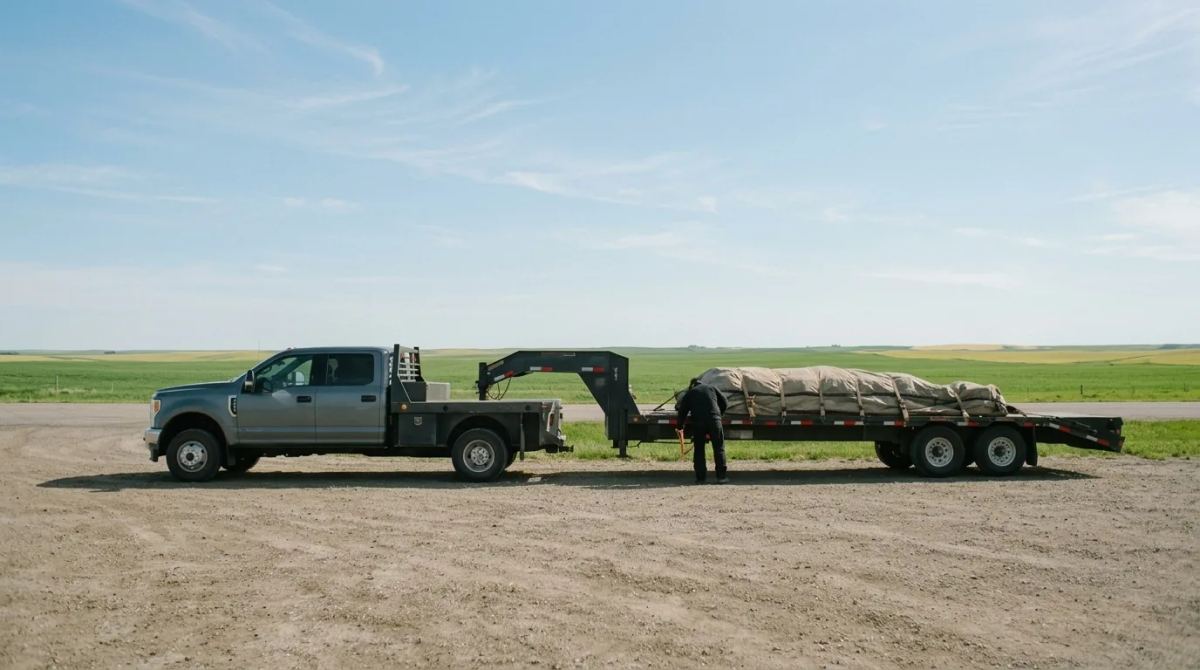
Flatbed freight shipping moves cargo on an open deck with no sides and no roof. It is the right mode when a load is too wide, too tall or too awkward for an enclosed trailer, or when it has to be lifted on by crane or forklift rather than pushed through a dock door. The trade-offs are weather, securement and, above a certain size, permits.
This guide covers when flatbed is the right call, where the legal limits sit, what actually drives the rate, and the part of securement that belongs to you rather than to the driver.
What is flatbed freight shipping?
A flatbed is a level platform trailer with no walls or roof. That open design is the entire point: it lets freight be loaded from the side, from above, or from either end, and it removes the dimensional ceiling that a dry van imposes.
Anything that fits inside a trailer and can be handled on a dock will usually be cheaper in a dry van, or on LTL if it is only a few pallets. Flatbed exists for everything else.
When flatbed is the right mode
Four situations, and most flatbed freight falls into at least one.
The freight will not fit inside a trailer. Too wide, too tall, or an awkward shape that cannot be squared up onto a standard pallet.
It has to be lifted rather than rolled. Machinery, structural materials and anything that arrives by crane or overhead lift needs a deck that opens from above.
There is no dock at one end. Construction sites, yards, and plants without a raised dock cannot receive an enclosed trailer in any practical way. An open deck can be unloaded anywhere there is lifting equipment.
The weight is concentrated. Dense freight that would sit as a single heavy point inside a van is easier to position and secure legally on an open deck, where the load can be placed to spread weight properly across the axles.
Flatbed trailer types and what each is for
| Trailer | Typical deck | What it is for |
|---|---|---|
| Standard flatbed | 48 or 53 ft, deck around 5 ft off the ground | General open-deck freight inside legal height |
| Step deck | Lowered rear deck, roughly 3 ft below the front | Taller freight. Gains two to three feet of cargo height and often removes the need for an overheight permit |
| Lowboy or RGN | Deck close to ground level | Very tall or very heavy freight. An RGN detaches at the front so wheeled equipment can be driven on |
| Hot shot | Smaller, usually a heavy-duty pickup and trailer | Urgent open-deck loads too small to justify a tractor-trailer |
A step deck is the one shippers most often overlook. If a load is a few inches over legal height on a standard flatbed, moving it to a step deck is usually cheaper and faster than applying for a permit.
Legal limits: how big before it becomes oversized
Federal limits set the baseline, and anything past them turns a routine load into a permitted one.
| Limit | Threshold |
|---|---|
| Width | 102 inches (8 ft 6 in) |
| Gross vehicle weight | 80,000 lb |
| Single axle | 20,000 lb |
| Tandem axle | 34,000 lb |
| Height | No federal limit. States set it, usually 13 ft 6 in to 14 ft 6 in |
Two of those catch people out. Height is a state matter rather than a federal one, so a load that is legal across one state line may not be across the next. And a load can sit comfortably under 80,000 pounds gross and still be illegal on an axle group if the weight is positioned badly.
Oversize permits, escorts and lead time
Once a load passes those thresholds it needs a permit from every state it travels through, and permits are the part shippers most often forget to budget time for.
Processing runs from a day to several weeks depending on the state and the size of the load. Wider and taller loads can require pilot or escort vehicles, and many oversize permits restrict travel to daylight hours, which lengthens transit on top of everything else.
The practical consequence: measure early. A load that turns out to be 104 inches wide rather than 102 does not simply cost a little more, it changes the paperwork, the route and the pickup date.
Securement: who is actually responsible for what
Most guides say the shipper and the carrier share responsibility, then leave it there. The split matters, because getting your half wrong is what turns into a claim.
The driver owns securement on the road. Tie-downs, chains, binders, edge protectors, the inspection before moving and the checks along the way are all the driver's legal responsibility under the FMCSA cargo securement rules. The rules are specific: at least two tie-downs for an article up to five feet, one more for every additional ten feet, and every tie-down rated to a working load limit of at least half the weight it is holding.
You own how the freight presents itself. Packaging, crating, banding, palletising, blocking and bracing, and above all declaring accurate dimensions and weight. A driver can secure a well-built crate properly. Nobody can secure a badly banded stack that is already shifting when the truck arrives, and a driver who refuses that load is doing their job.
The useful test before pickup: could this freight be lifted, set down and driven a hundred miles without changing shape? If the answer is no, the problem is on your side of the line and it is cheaper to fix on the dock.
Why securement history should decide your carrier
This is the part of flatbed nobody writes about, and it is the one with the most money attached.
Cargo securement violations are among the most common findings in roadside commercial vehicle inspections, and they feed directly into a carrier's safety record. A carrier with a pattern of securement violations is not an abstract risk. It is a truck more likely to be pulled out of service with your freight on it, on a shoulder somewhere, while your delivery window closes.
Which makes carrier selection the single biggest quality decision on an open-deck load. LT2 verifies operating authority, insurance and safety history before a carrier touches your freight, and monitors it on an ongoing basis rather than checking once at setup. On a dry van that is good practice. On a flatbed it is the specific thing that predicts whether your load arrives.
It is also a fair question to ask any provider: not whether they vet carriers, but what they actually look at.
Tarping, and why it costs what it costs
Not every open-deck load needs a tarp. Weather-sensitive freight does, and so does anything that road grime would damage.
Tarping is heavy manual work. A flatbed tarp commonly weighs eighty pounds or more, and fitting one means a driver climbing onto the load to spread and anchor it, often outdoors in whatever weather made the tarp necessary. That is why tarped freight prices higher than untarped, and why some carriers decline it. It is labour and it carries genuine physical risk, not an administrative surcharge.
Rolling-tarp equipment removes the climbing entirely by covering the load mechanically, which is worth asking about when freight needs protection and the schedule is tight.
What drives a flatbed rate
Published comparisons put open-deck freight somewhere above enclosed freight without agreeing on how much, which is unhelpful because the gap depends almost entirely on the load. What actually moves the number:
Dimensions relative to the legal limits. Comfortably legal freight prices like ordinary truckload. Freight near a threshold prices for the risk of crossing it. Freight past it prices for permits, routing and possibly escorts.
Which trailer it needs. A step deck costs more than a standard flatbed, and an RGN or lowboy more again, because the equipment is scarcer.
Whether it needs tarping. Covered above, and it is real labour.
Loading and unloading. A crane waiting at both ends is a fast turn. A site with one forklift and no plan is not, and dock time gets priced eventually.
The lane. Open-deck freight is more regionally concentrated than dry van, so a lane running out of a market with plenty of flatbeds prices better than one where the truck comes in empty.
What to have ready before you book
Five things, and having them ready is the difference between a quote that holds and a quote that grows.
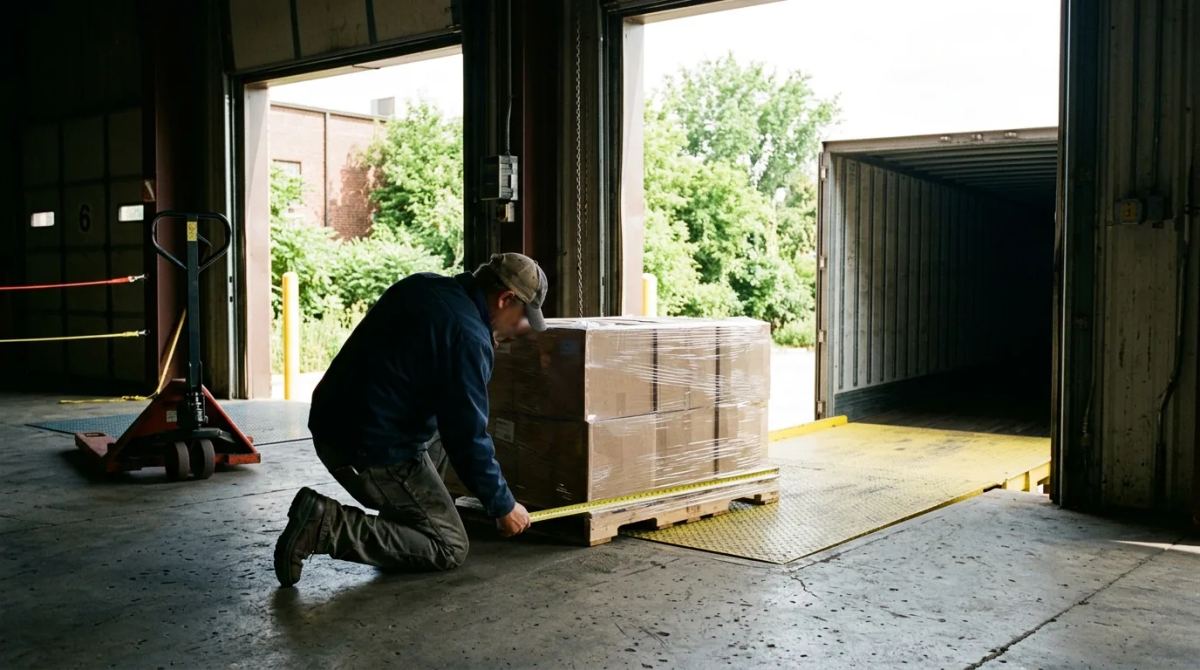
Measurements. Length, width, height and any overhang, measured rather than estimated, including anything protruding.
Weight, and where it sits. Total weight, plus whether it is concentrated at one point rather than spread across the footprint.
How it loads and unloads. Crane, forklift, rolled on, or driven on, at both ends.
Whether it needs covering. Say so up front rather than at pickup.
Anything past 102 inches wide. Flag it immediately. That single number decides whether this is a routine load or a permitted one.
Getting flatbed capacity through LT2
LT2 Logistics arranges flatbed capacity across the United States and into Canada: standard 48 and 53 foot flatbeds, step decks for taller freight, and hot shot equipment for smaller urgent open-deck loads.
We are a brokerage backed by Laufer Trucking, an asset-based carrier that has been running its own flatbeds out of Wisconsin since 1977. The freight moves on partner carriers. The judgement about what an open-deck load actually needs comes from an operator.
Send us the dimensions, the weight and how it loads at either end, and we will tell you what equipment it needs before you book anything. If it is close to a permit threshold, we would rather find that out now than at the gate. Call (262) 888-3553 or send the details over. More on our flatbed service.